Difference of two squares
Learn the method, practise it, then try real exam questions.
ATeaching
Example 1
Factorise x² − 49
- 1Notice that there are two square terms (a square letter and a square number) with a subtraction sign between them.
- 2This is the difference of two squares and is factorised into double brackets. Write the double brackets:
( )( ) - 3Work out the square root of x² and write this at the start of each bracket:
√x² = x
(x )(x ) - 4Work out the square root of 49 and write this at the end of each bracket:
√49 = 7
(x 7)(x 7) - 5Put a + between the terms in one bracket and a − in the other.
(x + 7)(x − 7)
Example 2
Factorise 4x² − 25
- 1Notice that there are two square terms (a squared term and a square number) with a subtraction sign between them.
- 2This is the difference of two squares and is factorised into double brackets. Write the double brackets:
( )( ) - 3Work out the square root of 4x² and write this at the start of each bracket:
√4x² = 2x
(2x )(2x ) - 4Work out the square root of 25 and write this at the end of each bracket:
√25 = 5
(2x 5)(2x 5) - 5Put a + between the terms in one bracket and a − in the other.
(2x + 5)(2x − 5)
BQuestion generator
Want other topics or a printable sheet? Go to Question generator →
CWorksheet
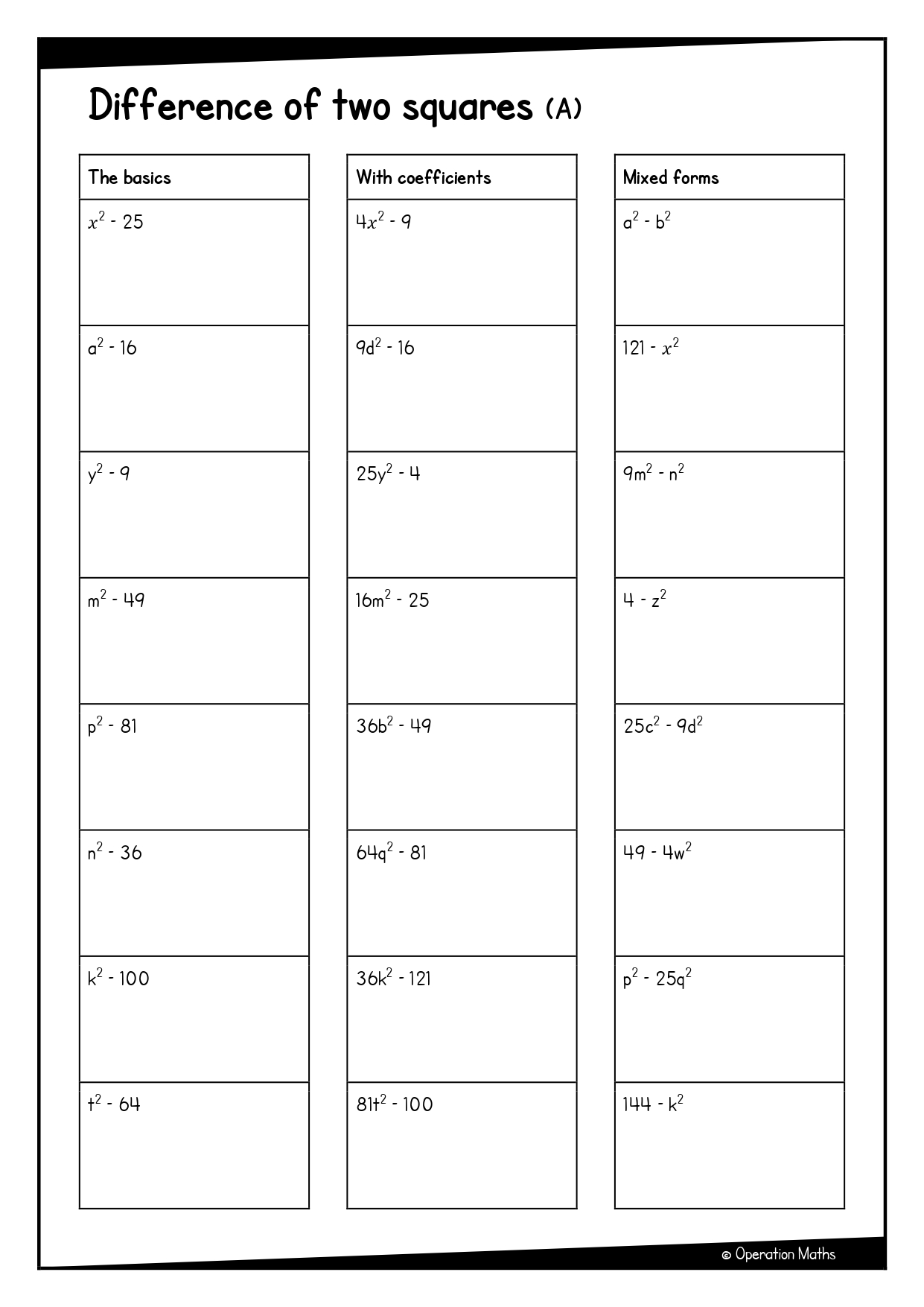
Difference of two squares
Each worksheet contains questions on factorising the difference of two squares with the basics, coefficients and mixed forms.
DPast exam questions
Want more? Browse the GCSE question bank →